SROI for CSR in India: A Practical Guide to Measuring Social Return on Investment
 Team TechCSR
18 Aug 2026
Team TechCSR
18 Aug 2026
Ninety-one out of 250 Nifty-listed companies disclosed impact assessment information in their most recent annual reports, out of 114 that were eligible to report it. That gap is the entire problem in one statistic: even among India's largest, best-resourced companies, a meaningful share still is not measuring what their CSR spend achieves.
If you run CSR for a company that crosses the Rule 8(3) thresholds, this is not a future problem. It is this year.
What Is SROI in CSR?
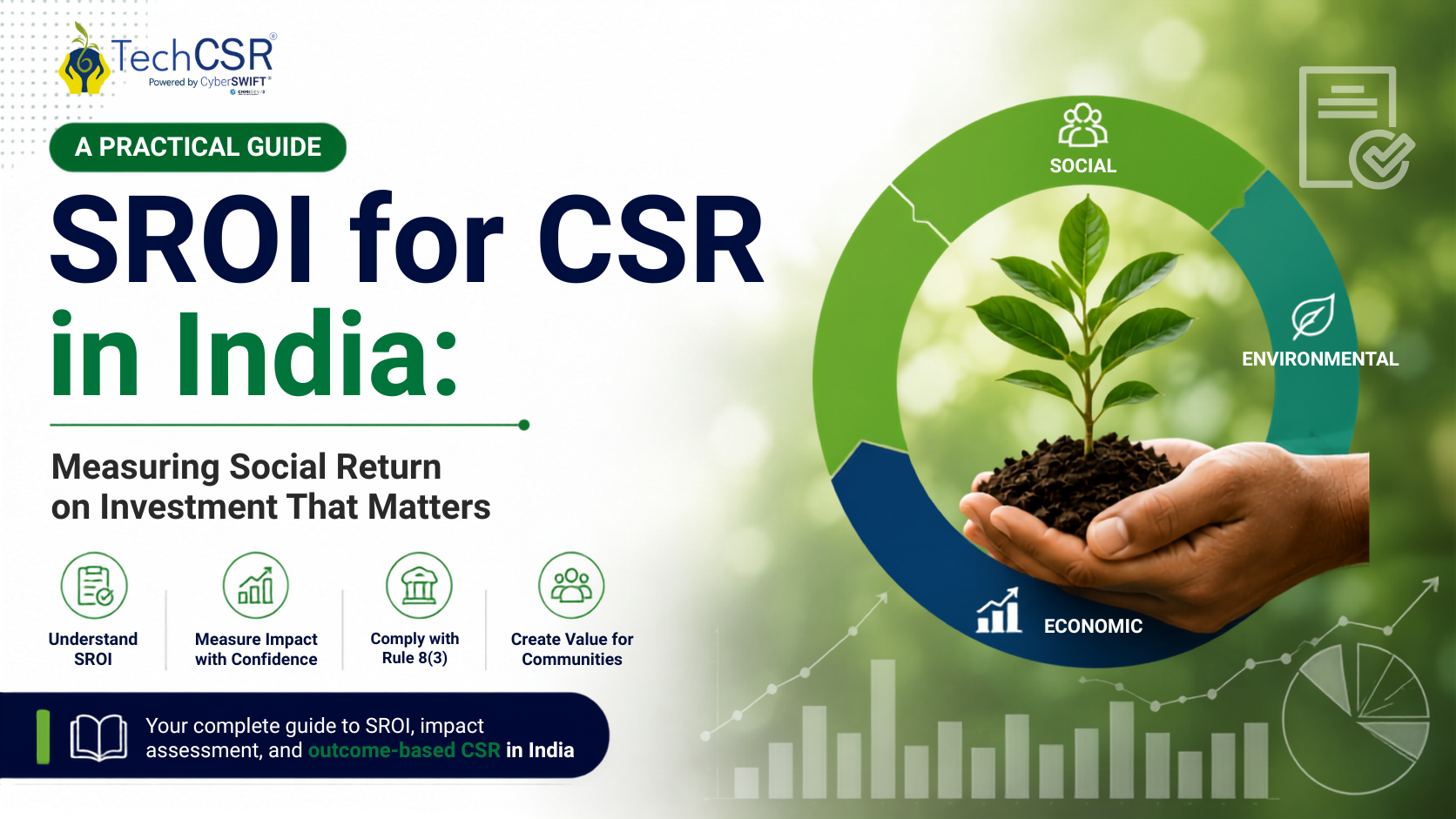
Social Return on Investment (SROI) is a method for expressing the social, environmental, and economic value a CSR project creates as a monetary ratio against what it costs. An SROI of 3.2:1 means every ₹1 invested generated ₹3.20 of social value for the people and communities affected.
SROI was standardised by Social Value International (formerly the SROI Network) and is built around a simple idea: financial statements capture what a project was spent, but not what changed. SROI tries to put a number on the change, increased income after a skilling program, reduced healthcare costs after a sanitation intervention, improved school attendance after a nutrition drive, using the same rigor a finance team would apply to a balance sheet.
It is not the only impact measurement framework CSR teams use in India, balanced scorecards and straightforward output tracking are common too, but SROI is the one most CSR heads, boards, and evaluators reach for first because the ratio format is instantly legible. A single number, defensible on request, that answers "was this worth it?"
Why SROI and CSR Impact Measurement Matter for Indian Companies
Section 135 of the Companies Act, 2013 requires companies above certain net worth, turnover, or profit thresholds to spend at least 2% of average net profit on CSR. That part is well known.
What is changed the game is the 2021 amendment, Rule 8(3) of the Companies (CSR Policy) Rules, which made third-party impact assessment mandatory for:
- Companies with an average CSR obligation of ₹10 crore or more in the three preceding financial years, and
- Individual CSR projects with an outlay of ₹1 crore or more, completed at least one year before the assessment
For companies that clear both thresholds, an independent agency has to evaluate the social, economic, and environmental effects of the project, and the resulting report goes to the Board and gets annexed to the CSR report.
The regulatory direction is explicit: the focus is shifting from compliance (did we spend 2%?) to return (what did that 2% actually produce?). SROI, alongside balanced scorecards, is the framework most consistently cited as the answer to that second question.
In short: if your CSR obligation and project sizes put you inside the Rule 8(3) thresholds, you are not choosing whether to measure impact, only how well you do it.
The Six Stages of Social Return on Investment (SROI) Analysis
A SROI study follows a fixed, six-stage process defined by Social Value International. Skipping or compressing a stage is the single most common reason an SROI ratio does not survive scrutiny.
1. Establish scope and identify stakeholders. Define what is being measured, over what time and geography, and who experiences change, direct beneficiaries, their families, staff, implementation partners, even the wider community.
2. Map outcomes. For each stakeholder group, build a theory of change: what changes for them, described from their perspective, not as a list of what your organisation did.
3. Evidence outcomes and assign financial proxies. Collect data showing the outcomes genuinely occurred, then attach a defensible monetary value to each. A "financial proxy," since most social outcomes (confidence, employability, health) have no direct market price.
4. Establish impact. Strip out deadweight (what would have happened anyway) and attribution (credit that belongs to other actors or programs), so the ratio reflects only the change your project caused.
5. Calculate the SROI ratio. Sum the net social value across all outcomes and divide by total investment, including in-kind contributions.
6. Report, embed, and use the findings. An SROI number is only useful if it changes decisions, this stage is about sharing results with stakeholders, feeding them back into project design, and setting the process up to repeat.
How to Calculate SROI: The Formula and a Worked CSR Example
The core formula is simple: SROI Ratio = Total Present Value of Social Impact ÷ Total Value of Investment. The work is in getting a defensible number for the numerator, that is what Stages 2–4 above exist to produce.
Here is how that plays out on a real project.
Scenario: A company spends ₹50 lakh on a one-year vocational skilling program for 500 unemployed youth in a rural district.
Step 1 — Identify the outcome. The core outcome stakeholders care about: participants who complete the program get a job or start a livelihood activity they did not have before, raising their income.
Step 2 — Evidence the outcome. Post-program tracking shows 300 of the 500 participants (60%) are in stable employment or self-employment six months after completion, with an average income increase of ₹8,000/month, sustained for an estimated 3 years before the effect would naturally fade (a standard "drop-off" assumption in SROI work).
Step 3 — Assign a financial proxy and calculate gross value. ₹8,000/month × 12 months × 3 years = ₹2,88,000 per participant, across 300 participants = ₹8.64 crore gross value.
Step 4 — Adjust for deadweight and attribution. Evaluators estimate 25% of participants would likely have found similar work anyway (deadweight), and that a state government scheme running in parallel deserves 15% of the credit (attribution). Net impact = ₹8.64 crore × (1 − 0.25) × (1 − 0.15) = ₹5.51 crore.
Step 5 — Discount to present value (for outcomes realised over multiple years, a discount rate, commonly 3.5%, in line with public-sector guidance, is applied; for a single-year program this step is often skipped or minor).
Step 6 — Calculate the ratio. ₹5.51 crore (net social value) ÷ ₹50 lakh (investment) = an SROI of approximately 11:1 — every ₹1 spent generated roughly ₹11 of social value.
That ratio is only as credible as the assumptions behind it. A ratio built on a self-reported "we think it helped" survey was not held up to an evaluator or a Board; a ratio built on tracked employment outcomes, a stated deadweight/attribution methodology, and independent verification will.
The practical takeaway: the calculation itself is one formula and a few multiplications. What makes or breaks it is whether you have real outcome data (participants actually tracked post-program, not assumed) and honest, documented deadweight/attribution assumptions, which is exactly the data most CSR teams do not have on hand unless it was captured during the project, not after.
Where CSR Teams Actually Get Stuck
The theory is straightforward. The practice usually breaks at Stage 2 and Stage 3.
Most CSR reporting in India is built around outputs, beneficiaries trained, units distributed, villages covered, because that is what is easiest to collect and what compliance reporting has historically asked for. SROI needs outcomes: what changed for those beneficiaries afterwards. Did their income actually rise? Did health indicators improve? That is a different data collection exercise, and it must start when the project is designed, not when the report is due.
By the time a project has closed and an evaluator shows up asking for baseline data and outcome evidence, it is usually too late to collect it properly, which is exactly why third-party impact assessments so often end up thinner than they should be, and why demonstrable SROI is harder to produce than the framework itself suggests.
How to Start Measuring CSR Impact Without Overcomplicating It
You do not need SROI across your entire CSR portfolio on day one.
- Pilot on one flagship program first. Picking the project with the clearest, most measurable outcome, a livelihood or skilling program, is often the easiest starting point because income change is straightforward to evidence.
- Define 2–3 outcome indicators before the project launches, not after. This is the single highest-leverage decision in the whole process.
- Capture outcome data as the project runs, not retrospectively. Field reporting, beneficiary tracking, and structured data capture at the point of delivery are what make Stage 3 (evidencing outcomes) possible later. This is precisely the gap most CSR teams discover too late.
- Bring in independent verification once you have real outcome data to verify. Third-party review is what gives an SROI number credibility with your Board, auditors, and the Ministry.
How CSR Software Supports Outcome Tracking and SROI Readiness
The biggest obstacle to SROI is often not the calculation; it is the availability and quality of outcome data. CSR software can help organizations build that data discipline into project execution instead of reconstructing evidence months later.
TechCSR supports this process through beneficiary and field data capture, mobile field reporting, GIS-enabled need assessment, and structured CSR monitoring. When data is captured during implementation, CSR teams have a stronger foundation for outcome measurement, impact assessment, CSR reporting, and future SROI analysis.
For organizations looking to move from spreadsheet-based CSR monitoring to a more structured approach, the objective is not simply to automate reporting. It is to create a reliable information trail from need assessment project planning -> implementation -> beneficiary outcomes -> impact measurement - > reporting.
The Takeaway
SROI is not complicated in concept, it is a ratio of social value to cost. What is hard is the data discipline behind it: defining outcomes before a project starts, capturing evidence as it runs, and being honest about what your project caused versus what would have happened anyway.
Companies that treat SROI as a reporting season scramble will keep producing thin, defensive impact assessments. Companies that build outcome tracking into how they run CSR projects, from day one, not from report-writing day, will be the ones with a number they can stand behind.